
ASK A TEACHER ANYTHING


Do you know what you know?
Most students think they know a topic because it looks familiar. But recognition isn’t understanding. Before you revise, you need to be honest about what you truly understand and what you don’t. That’s how you stop guessing and start improving.
FIRST YOU MUST:


Know Exactly What You Need to know and what you don't!
Before you revise anything, you need to know exactly what the exam board expects you to know.
Every GCSE subject has a Specification.
This is the official list of what you can be tested on.
This works for any exam board and any subject.
How to Find It
1️⃣ Find your exam board (AQA, Edexcel, OCR, etc.).
Google: [Exam board] GCSE [Subject] specification
2️⃣ Open the official exam board website.
3️⃣ Download the Specification PDF.
We’ve included direct links on the below pages for:


Go to the Right Section
Open the document.
Scroll down the PDF
Find the section called:
Subject Content or Knowledge, Skills, and Understanding
This is the exact list of everything you need to know.
Use this as your checklist for revision.
If it is not in this list it shouldn't be in the exam.
This will save you revising more than you need to.
And allow you to focus on the areas you don't know well.
THEN YOU SHOULD:

Break It Down and Check Yourself
Once you’ve found the Subject Content section of the specification, don’t look at it as one big subject.
Break it into topic sections.
Specifications are organised into numbered topics like:
3.1 Number
3.2 Algebra
3.3 Ratio, Proportion, Rates of Change Etc

Each numbered section is a topic
You are not revising “English” or “Maths.”
You are revising what is within each topic section:
-
Structure
-
Themes
-
Fractions
-
Decimals
-
Percentages etc
Small sections make revision focused and manageable.
Use this as your checklist.
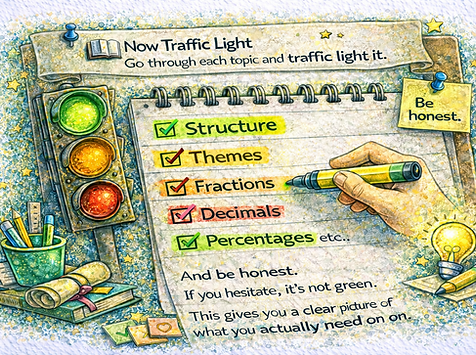
Now Traffic Light
Go through each topic and traffic light it.
🟢 Green – I can explain this clearly.
🟠 Orange – I sort of understand it.
🔴 Red – I don’t understand this yet.
And be honest.
If you hesitate, it’s not green.
This gives you a clear picture of what you actually need to work on.
IT'S A GOOD IDEA TO:

Double check what you already know
The smartest way to revise is to teach someone else.
If you can teach a topic simply, you understand it.
If you can’t teach it, you’ve found the gap.
This method is called the Feynman Technique.
Use this for any topic: English, Maths, Business, Science, everything can be studied using this method.
Write the Topic Clearly
At the top of the page, write the exact topic you are revising.
Examples:
-
Narrative Structure
-
Persuasive Techniques
-
Algebraic Fractions
-
Ratio
Be specific.
This focuses your brain.


Now explain It to a Friend
Imagine a friend missed the lesson.
Write a short explanation as if you’re helping them understand what they missed.
-
No notes.
-
No textbook.
-
No slides.
Keep it clear and simple.
This shows what you really know.
Check against the content
Now compare your explanation to:
-
Class notes / teacher slides
-
Revision guide
-
Ask your teacher (or ask us)
Highlight:
-
What you missed
-
What isn’t fully correct
-
Where you hesitated
These are your weak areas.


Teach it to a five year old
Imagine you are now teaching this topic to a small child. Rewrite to include everything you missed and corrected.
Not dumbed down, just simple. Because if you can’t explain something simply, you don’t fully understand it yet.
Think of all the questions a five year old might ask you. Why does it matter, what do you mean etc
And keep repeating the last five steps known as the Feynman method until explaining it is easy.
NOW YOU CAN:

Revise Strategically
🔴 Go Deep on anything you traffic lighted as red.
Relearn anything that you have re highlighted as red, after you have completed the Feynman Method above:
• Notes / slides & revision guide
• Flashcards / Kahoot
• Focused practice exam questions
Ask a teacher (or ask us) to recap anything you’re stuck on
Refine and Strengthen
🟠 You mostly understand the topic's you have highlighted in orange, but there are still small gaps in your knowledge:
• Identify exactly what’s unclear using the Feynman Method
• Fix definitions or steps
• Practise a small number of focused exam questions
Turn “almost” into “secure.”


Maintain and Retain
🟢You clearly understand topics you have highlighted in green, so you do not need to spend the majority of your revision time on these areas.
• Quick recall (no notes)
• Mixed-topic questions
• Timed mini tests
Keep it sharp.
Confidence comes from consistency — not over-revising.